Centro per lo studio e la sperimentazione di strumentazione meteorologica

Welcome to KWOS website

Octocatfacebook icon 512 512Instagram AppIcon Aug2017 
UTC Time
English French German Italian
Stimare il rainfall rate con il segnale ricevuto da una parabola televisiva

rain fade La televisione satellitare o televisione via satellite, è la televisione che giunge agli utenti in broadcast o multicast per mezzo di onde radio emesse da trasmettitori posti su satelliti per telecomunicazioni geostazionari.

I segnali trasmessi sono modulati su una portante da e verso il satellite. In generale le tipologie di sistemi satellitari per telecomunicazioni si differenziano tra loro nelle loro caratteristiche tecniche in base all'applicazione o destinazione d'uso (es. broadcasting, telefonia satellitare, internet satellitare, sistemi di radiolocalizzazione e radionavigazione).

Le frequenze utilizzate per i setelliti televisivi, in genere, sono quelli della banda Ku (12–18 GHz), mentre quelli per internet satellitare, sono solitamente sulla banda Ka (26,5–40 GHz).

Durante la visione di un programma televisivo, quasi tutti ci siamo imbattuti in una perdita di segnale durante un temporale. Contrariamente a quello che molti credono, non è lo spessore della coltre di nubi ad attenuare i segnali satellitari ma la concentrazione di gocce d’acqua nell’atmosfera e nelle stesse nubi. In pratica è lo stesso fenomeno che si manifesta nel funzionamento di un forno a microonde. Una radiazione elettromagnetica ad alta frequenza (come quella generata dalle trasmissioni satellitari e dal Magnetron presente nel forno) produce oscillazioni nelle molecole che possiedono polarizzazione come l'acqua: aumentando il moto, l'energia viene convertita in calore e il segnale diventa più debole.
Leggi di più >>>

Observing equipments


Automated airport weather stations use a variety of sophisticated equipment to observe the weather.

Wind speed and direction

 
ASOS Ice Free Wind Sensor

A majority of older automated airport weather stations are equipped with a mechanical wind vane and cup system to measure wind speed and direction. This system is simple in design: the wind spins three horizontally turned cups around the base of the wind vane, providing an estimation of the wind's speed, while the vane on top turns so that the face of the vane offers the least resistance to the wind, causing it to point in the direction the wind is coming from and thus providing the wind direction.

The new generation of sensors use sound waves to measure wind speed and direction. The measurement is based on the time it takes for an ultrasonic pulse to travel from one transducer to another, which varies depending on - among other factors - the wind speed. The transit time is measured in both directions for several (usually two or three) pairs of the transducer heads. Based on those results, the sensor computes wind speed and direction. Compared to mechanical sensors, the ultrasonic sensors offer several advantages such as no moving parts, advanced self-diagnostic capabilities and reduced maintenance requirements.
read more >>>

Papouch TH2E sensor

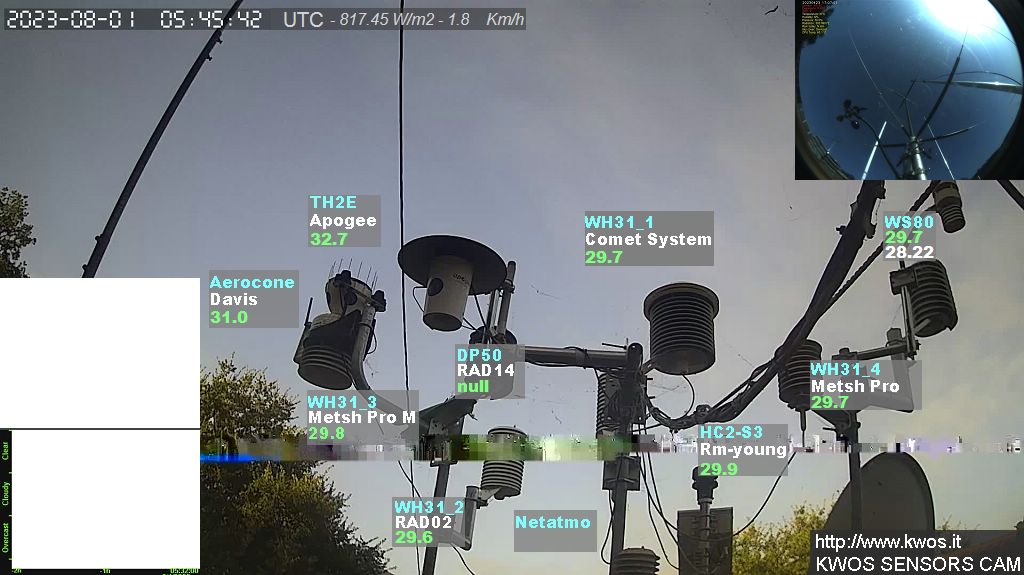
Presso la sede del KWOS è in prova, all'interno dello schermo solare Apogee TS-100, il sensore termo/igrometrico della Papouch: TH2E

Si tratta di un sensore digitale con una interfaccia Web e tante altre funzionalità di invio dati.
read more >>>

Scandriglia weather

All Sky cameras


Copyright © 1998 - 2024 KWOS.org - KWOS.it - IW7CHV.org - IZ0QWM.org. All rights reserved.

Histats page for KWOS.it  - Histats page for KWOS.org - 
 
 -  Statscounter page for kwos.it

KWOS Coordinates

Grid locator: jn62je

Lat: 42°10' 07.3" N 
(42.168694°) 
Long: 
12°47' 09.8" E     
(12.786056°) 
CQ zone:
 15 
ITU zone:
 28

 
logo cisarlogo ara